
July 10, 2025
Disability and Work Topics 101: Understanding “Barriers” for People with Disabilities


Disability and Work Topics 101: Understanding “Barriers” for People with Disabilities
Authors: Lauren Renaud, Melissa Pagliaro, Rachel Bath
Visuals by: Ramitha Muralitharan
Audio Narrator: Noor Al-Azary
Audio Version:
Introduction
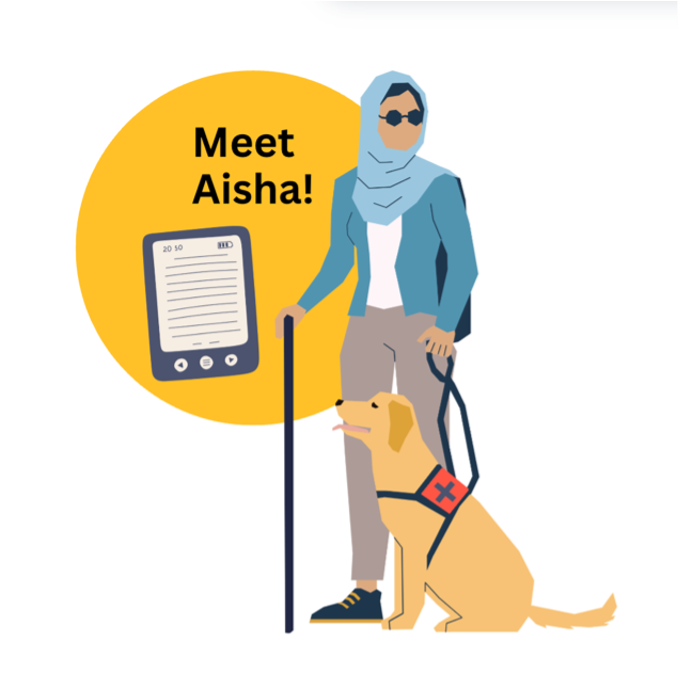 Aisha is a young professional who just finished university with a degree in marketing. She is excited to start her career, but she is running into some challenges. Aisha is blind, and she uses a screen reader on her computer and a guide dog to get around. As she looks for her first career job, Aisha is facing something we call “barriers.” But what does that mean?
Barriers come in many forms. For example:
- A building without a ramp or elevator is a physical barrier for someone who uses wheelchairs, canes, or walkers
- A website that doesn’t work for a screen reader is a digital barrier for someone who is blind, like Aisha
- A job interview where the employer assumes a person with a disability can’t do the work is an attitudinal barrier
In this blog post, we’ll explore some barriers for people with disabilities, especially when it comes to work.
Understanding Barriers for People with Disabilities
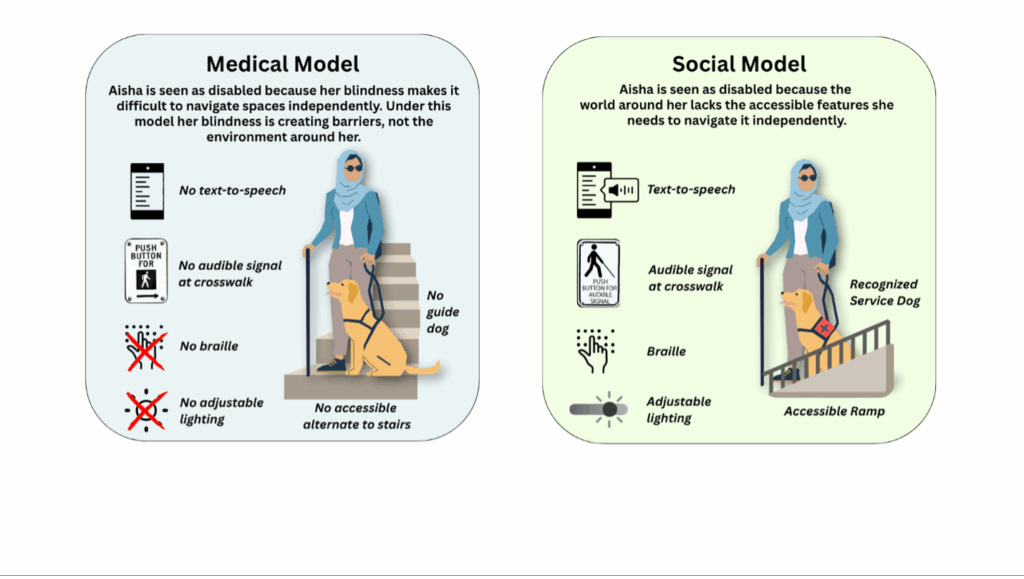
In the past, up until around the late 20th century, people thought about disability very differently. Disability was seen as a medical problem: it was something “wrong” with a person’s body or mind that needed to be fixed. People with disabilities were expected to change themselves to fit into society. If they couldn’t, they were often left out.
But starting in the 1970s and 1980s, especially in the United Kingdom, people with disabilities began to challenge this idea. Activists and scholars introduced a new way of thinking about disability. One of them, Mike Oliver, helped develop what’s now called the “social model” of disability. [1]
The social model says that people aren’t disabled by their bodies or minds, but by barriers that are in the world around them. Someone might have a characteristic like blindness (as Aisha does), but that doesn’t mean they’re automatically disabled. What makes life harder are the barriers in society, like buildings without braille signs, or websites that don’t work with screen readers. These barriers create disability.
The idea of barriers is central to the social model. A barrier is anything in the environment—like buildings, technology, or attitudes—that makes it harder for people with disabilities to take part in everyday life. There are many kinds of barriers for people with disabilities, which we will look at shortly.
But first, let’s go back to Aisha. The medical view would say she’s disabled because she can’t see. But the social model says she’s disabled by a world that’s built for people who can see. For example, if there’s no braille on signs, she can’t find her way around. If a crosswalk doesn’t make a sound, she doesn’t know when it’s safe to cross the street. These are examples of barriers created by society, not by Aisha’s blindness. If those barriers didn’t exist, and signs and crosswalks were built accessibly with braille and sound, Aisha wouldn’t be “disabled.” She’d be navigating the world like people without disabilities.
Interpersonal Barriers: How People Can Make Things Harder—Even When They Don’t Mean To
The first kind of barriers for people with disabilities that we will talk about in this post are interpersonal barriers. Interpersonal barriers are barriers that happen between people. They come from how people treat other people with disabilities, especially when they have misunderstandings, biases, or negative attitudes about disability. These kinds of barriers can happen between individual people, within groups of people, or across groups of people.[2]
In the workplace, interpersonal barriers can take many forms. It might look like stigma about disability, discrimination, and ableism (the belief that not having a disability is ‘normal’ and that people with disabilities are less than because of their disability). For example, employers may think workers with disabilities are less productive than workers without disabilities, and that accommodations are too expensive, even though both ideas have been proven to be untrue.[3][4]
In Aisha’s case, she experienced interpersonal barriers during a recent job interview. When she arrived with her guide dog, the interviewer seemed uncomfortable and distracted. Instead of focusing on Aisha’s qualifications, the interviewer kept asking questions about the dog. Even though Aisha was prepared and confident in the interview, the interviewer didn’t ask her about her skills or experience until the end. She left the interview feeling like she wasn’t taken seriously as a professional.
In this situation, Aisha experienced an interpersonal barrier because of the attitude and assumptions of the interviewer. The interviewer may not have meant to be disrespectful, but their focus on her guide dog instead of Aisha’s abilities showed a lack of understanding that made Aisha feel excluded.
Individual Barriers: The Barriers We Bring with Us
While interpersonal barriers come from how other people treat someone with a disability, individual barriers come from how a person might feel about themselves or the things they might believe about themselves. For example, sometimes people with disabilities struggle with self-confidence because of how they have been negatively treated by others in the past.[2]
While the negative treatment they received is an interpersonal barrier because it involves other people, the lack of self-confidence they feel after is an individual barrier because it has to do with how they view themselves.
There are lots of ways that individual barriers can impact people at work. For example, someone who feels less confident might be uncomfortable telling their employers when they need accommodations at work.[5][6]
This is exactly what has happened to Aisha: based on bad past experiences, she is worried about what employers will think of her because she has a disability. Every time she wants to apply for a job, she must fight her own feelings of nervousness and inadequacy. Sometimes she chooses not to apply to interesting jobs because she is afraid of how she will be seen. Her own beliefs now create barriers and limit her opportunities.
Community Barriers: When What’s “For Everyone” Isn’t for You
Community barriers are barriers for people with disabilities within the local community,[2] such as in public transportation, public spaces like parks, restaurants, and grocery stores, and community events like the farmer’s market around the corner or the festival downtown. Sometimes these community services, places, or events are not accessible. For example, public transportation can be unreliable, unavailable, unsafe, or inaccessible for people with disabilities.[7][8]
Aisha’s friend had told her about a local job fair. Her friend had talked about how easy it was to go and learn from different companies about the kinds of jobs they offer, so Aisha was excited to attend the next one. But when she went to the job fair, she was disappointed. The event took place in a local community centre, and there were no tactile signs available to help her find her way through the event. There also weren’t any people acting as guides to help her, so she didn’t know where to go to find the companies that were hiring in her field. Even though the job fair had helped her friend, Aisha missed out on the networking opportunity it offered because the organizers hadn’t considered the needs of blind attendees when planning the event.
Institutional Barriers: When “It’s Just the Way Things Are” Is a Problem
Sometimes the way major social institutions like schools, workplaces, and banks are run also creates barriers for people with disabilities. For example, schools might not have accessible washrooms or ramps at entry spaces. They may have poor quality accommodations, or barriers to accessing accommodations. And some of the things you can do through schools, like co-ops, might not be accessible.[9][10]
Workplaces, too, might have barriers because of the way they are run. Some companies use inaccessible application and recruitment processes without realizing it. Others have workplace cultures that are not inclusive and welcoming, or accommodation processes that make it difficult for employees with disabilities to secure accommodations. [4]
Aisha has experienced these barriers as well. The last job she found seemed like a very good fit for her skills and experience. She had found the job ad posted on a job board. Applicants had to apply through the company’s website, so she went to their site. However, the company’s online application portal was very dated and didn’t work with her screen reader. She went back to the job ad on the job board to look for different ways to apply, but none were described. Eventually, despite feeling excited about the job, she decided not to apply, because there was no way for her to submit her application. Although Aisha was qualified for the position, she was excluded from the hiring process due to the company’s use of inaccessible technology.
Removing Barriers to Employment for People with Disabilities
At CCRW, we often talk about barriers to employment for people with disabilities. There are many different barriers that people can experience when looking for work, working, or trying to get a promotion. By identifying these barriers and the impacts they have on people with disabilities, we can begin to fix them and make work more accessible for everyone.
Resources
Want to learn more about the barriers that people with disabilities face at work? Check out our 2024 Trends Report, available in both text and audio formats. From career advancement to workplace inclusion, this report breaks down common barriers and provides solutions.
Are you a jobseeker with a disability? Do you find some parts of work hard to navigate, like asking for accommodations or talking about your disability? Our VR tool gives you a chance to practice real-life situations in a safe, hands-on way. Build your confidence and learn how to deal with common workplace barriers before they happen.
References
-
[1] Oliver, M. (1983). Social Work with Disabled People. Palgrave Macmillan.
-
[2] Pike, I., Richmond, S., Rothman, L., & Macpherson, A. (Eds.). (2015). Canadian injury prevention resource. Parachute.
-
[3] Nagtegaal, R., de Boer, N., van Berkel, R., Derks, B., & Tummers, L. (2023). Why do employers (fail to) hire people with disabilities? Journal of Occupational Rehabilitation, 33, 329–340. https://doi.org/10.1007/s10926-022-10076-1
-
[4] Bonaccio, S., Connelly, C. E., Gellatly, I. R., Jetha, A., & Martin Ginis, K. A. (2020). The participation of people with disabilities in the workplace. Journal of Business and Psychology, 35(2), 135–158. https://doi.org/10.1007/s10869-018-9602-5
-
[5] Lindsay, S., McDougall, C., Menna-Dack, D., Sanford, R., & Adams, T. (2015). Barriers to employment for youth with disabilities. Disability and Rehabilitation, 37(8), 701–711. https://doi.org/10.3109/09638288.2014.939775
-
[6] Jetha, A., Bowring, J., Furrie, A., Smith, F., & Breslin, C. (2019). Transition into employment: Canadian young adults living with disabilities. Journal of Occupational Rehabilitation, 29(1), 140–149. https://doi.org/10.1007/s10926-018-9772-z
-
[7] Awsumb, J., Schutz, M., Carter, E., Schwartzman, B., Burgess, L., & Lounds Taylor, J. (2022). Pursuing paid employment for youth with severe disabilities. Research and Practice for Persons with Severe Disabilities, 47(1), 22–39. https://doi.org/10.1177/15407969221075629
-
[8] Wayland, S., Newland, J., Gill-Atkinson, L., Vaughan, C., Emerson, E., & Llewellyn, G. (2022). Discriminatory acts on public transport. Disability & Society, 37(2), 296–319. https://doi.org/10.1080/09687599.2020.1822784
-
[9] Moritz, L., Jackson, L., Gahagan, J., & Shaw, L. (2022). Experiences of postsecondary students with physical disabilities. Canadian Journal of Disability Studies, 11(2), Article 2. https://doi.org/10.15353/cjds.v11i2.893
-
[10] Owenz, M., Spencer, B., & Aydemir-Doke, D. (2024). “Institutional betrayal”: The return to normal and students with disabilities in the USA. Disability & Society, 1–25. https://doi.org/10.1080/09687599.2024.2400989

Subscribe
Sign up to receive updates from CCRW.