
April 30, 2026
Disability and Work Topics 101 Diverse Minds: Neurodiversity in the Workplace


Disability and Work Topics 101
Diverse Minds: Neurodiversity in the Workplace
Authors: Melissa Pagliaro
Visuals by: Melissa Pagliaro
Audio Narrator: Noor Al-Azary
Introduction
Many workplaces in Canada are built around unspoken ideas about how a “good worker” thinks, communicates, and acts. Being fast, talkative, comfortable with noise and interruptions, and able to manage social expectations is treated as part of the job.
While these unspoken ideas seem neutral, they can create barriers in the workplace for Autistic and neurodivergent workers. As a result, workers may hide their needs, mask their natural behaviours, or avoid asking for support out of fear of being seen as difficult or unprofessional.
Mari is a 48-year-old non-binary Latinx web designer at a tech start-up, known for their ability to spot patterns in code and quickly fix problems before they escalate. Their behaviour is often praised as “passionate”, though they are also criticized for being “too intense”. In meetings, Mari carefully watches their body language and resists using their fidget toy, even though it helps them focus, to avoid being misunderstood. They avoid asking for simple supports like adjustable lighting, closed offices, or acceptance of fidget tools, fearing that they will be seen as difficult rather than committed to their work.
Jordan, an Indigenous 23-year-old part time assembly kit worker, communicates with a speech app, gestures, and written notes. He is especially efficient at organized, step-by-step tasks such as sorting, assembling, and cleaning, and he takes pride in doing his work carefully. Jordan works best with clear instructions, predictability, and adequate time. These conditions enable him to produce consistent, high-quality results. Despite this, coworkers often speak over him or assume he doesn’t understand, and supervisors rush interactions. During busy periods, Jordan sometimes avoids using his device because it draws attention, even though it is essential for clear communication.
Sam is a 35 year old White grocery store cashier who is reliable and attentive to how the store functions day to day. She is often quick to notice when something is off, such as pricing mistakes, changes in workflow, or problems that could slow things down. Once Sam has seen something, like a shelf layout, a price, or where an item belongs, she can remember it clearly and recall it later without needing to check notes. During times of stress, such as loud noise, long lines, or unexpected problems, finding words becomes difficult. When Sam pauses or delays responding due to overwhelm, she is often told to “use her words” or “stop being rude”. She hesitates to ask for changes such as clear rules, short instructions, or extra help during busy periods because she fears losing hours or even her job.
What Mari, Jordan, and Sam have in common is that they are Autistic 1 and work in environments that were not designed with them in mind. Their stories show how everyday workplace norms, like expectations around communication, speed, noise tolerance, and “professional” behaviour, can create barriers and lead to burnout, isolation, and other long-term effects for Autistic people.
This blog is written for readers who want to better understand autism and neurodiversity at work, including why barriers exist and how workplaces can better support different minds.
Autism in the Workplace
There is no single Autistic experience 2. This is why Mari, Jordan, and Sam can all be Autistic while having very different work experiences and support needs. To understand why this variation is so common, it helps to look at how autism shapes people’s experiences at work.
One helpful way to think about this is through the idea of “spiky profiles” 3. Rather than having strengths and challenges evenly spread across all areas, many Autistic people have uneven profiles, with clear strengths in some areas and greater difficulty in others. Someone might have strong memory, pattern recognition, or focus, while finding task switching, sensory environments, or verbal communication under stress more challenging.
Autism influences how people communicate, process information, and experience the world around them 4. The infographic below highlights some common ways autism can show up, with images illustrating each example. Everyone is different, but examples include:
- Strong interests (dinosaur bones) – developing deep, sustained interests in specific topics or subjects and enjoying spending long periods focused on them
- Attention to detail (person with magnifying glass over a book) – noticing fine details, patterns, or inconsistencies that others may overlook
- Sensory sensitivities (person covering ears) – heightened sensitivity to sounds, lights, textures, smells, or other sensory input
- Overstimulation (person surrounded by arrows and symbols) – becoming overwhelmed when sensory input, social demands, or information coming in all at once
- Differences in planning and organization (head with clock) – challenges with starting tasks, managing time, switching between activities, or prioritizing work
- Self soothing behaviours (fidget toy) – using repetitive movements or actions, such as fidgeting or pacing, to regulate stress or focus
- Higher energy demands in daily life (low battery) – needing more energy to navigate routines, sensory environments, or social expectations
- Different communication styles (people communicating with text and images) – communicating through speech apps, written messages, visual supports, scripted phrases, or preferring clear and direct language
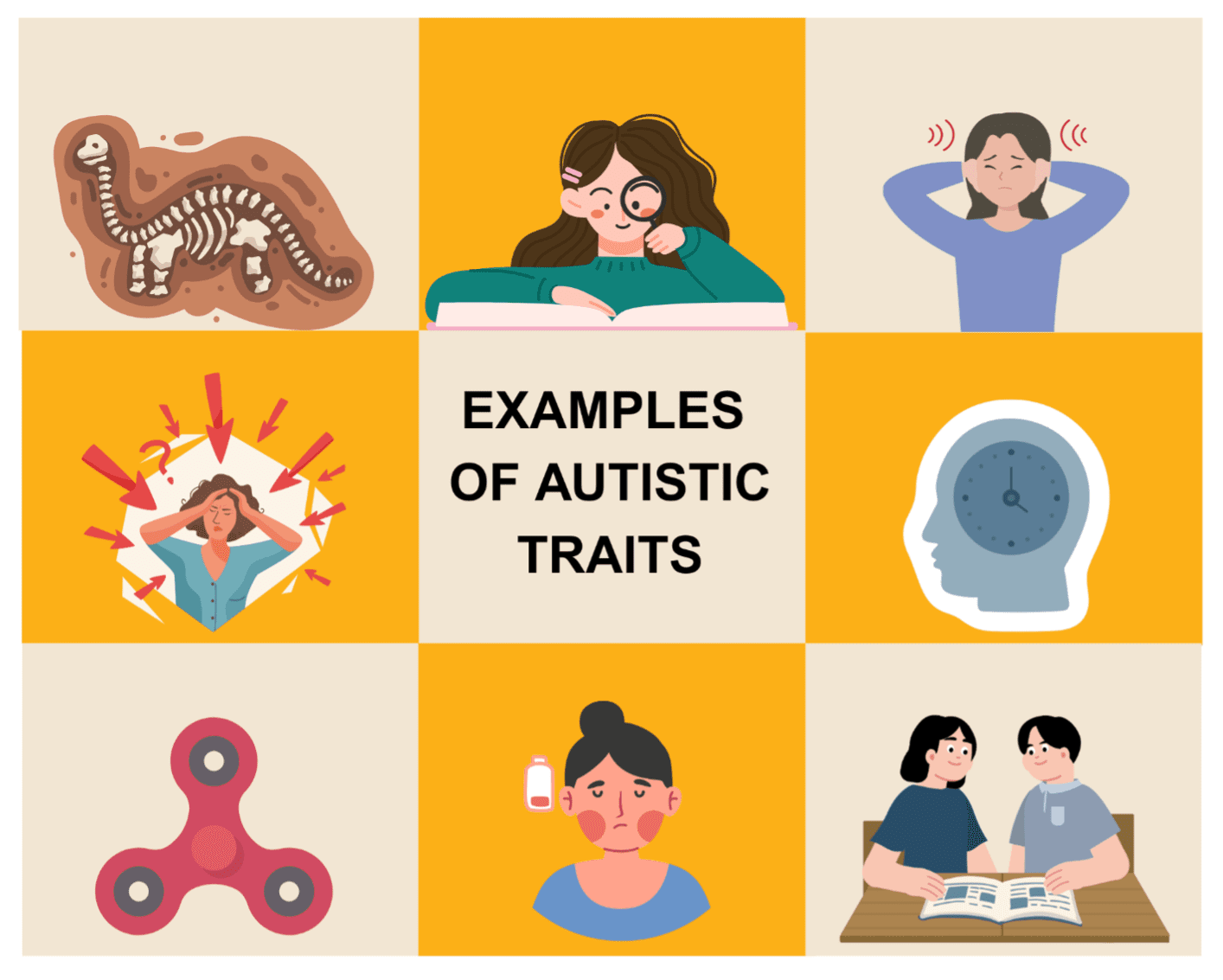
Autistic people may share common traits or patterns that shape how they engage with work. For example, strong focus and attention to detail can support accuracy, pattern recognition, and deep expertise. Mari’s enthusiasm for website design – and their ability to identify coding errors quickly – reflect how these traits can be beneficial at their work.
At the same time, fast-paced, unpredictable, or poorly structured work can be more difficult for some Autistic people, including Jordan and Sam. Having to change tasks a lot or having unclear expectations for tasks can make work even harder. Additionally, sensory experiences, such as noise, lighting, or crowded spaces, can be distracting or overwhelming, and may affect concentration, movement, or communication.
Autistic people also communicate in different ways. Some are very direct. Others may have limited eye contact or interpret body language differently. Some communicate using scripts, typing, gestures, written notes, or tools such as Augmentative and Alternative Communication (AAC), as Jordan does. AAC can be simple, such as gestures, writing, drawing, or pointing to letters and pictures, or more complex, like using speech-generating apps or computer-based tools 5.
Many people use repetitive movements or sounds, like nail biting, hair twirling, foot tapping, or pen clicking, to calm themselves, focus, or manage stress, often without thinking about it. Autistic people may also use these or more visible forms of self-soothing, sometimes called ‘stims’, such as rocking, humming, pacing, hand-flapping, seeking deep pressure, or using tools like fidget toys or noise-reducing headphones, especially in environments with bright lights, background noise, or uncomfortable textures 6, 7.Because workplaces often treat only certain types of regulation as acceptable, many neurodivergent people spend specific mental energy monitoring and suppressing these behaviours in public settings. This constant self-monitoring can be exhausting and is one factor that contributes to burnout at work.
To understand why these experiences are so common in workplaces, it helps to look at autism within the broader context of neurodivergence and neurodiversity.
Autism and Neurodiversity
![A banner with purple geometric accents and three illustrated hexagons on the left showing people working in different ways. One hexagon shows a person holding a chart with symbols, another shows a person wearing headphones and working on a laptop, and a third shows a person pointing downward with both hands. On the right, a quote reads, “Everyone has a different mind, a different way of being,” attributed to Vincent Camley, activist (Camley, 2005 [8].](https://ccrw.org/wp-content/uploads/2026/04/Autism-Graphic-2.png)
Autism is one form of neurodivergence – a term used to describe people whose brains work differently from what society typically expects 9. These differences can affect how people think, process information, experience sensory input, communicate, move, and connect with others.
Neurodiversity describes the broader idea that there is a full range of ways human brains can function 10, 11, 12. Just as there is no single “right” body type or personality, there is no single “right” brain. This means that variations experienced by Autistic people are natural and valuable. They are not problems to fix.
The neurodiversity movement emerged when Autistic people pushed back against being defined only in terms of what they lacked or struggled with 13, 14. Over time, the concept expanded to include many other differences in thinking and behaviour, including ADHD, learning disabilities, mental health conditions, multiple sclerosis, Parkinson’s disease, cerebral palsy, and others 98.
The terms neurotypical and neurodivergent help describe this.
Neurotypical refers to people whose ways of thinking, sensing, and communicating match with societal norms.
Neurodivergent refers to people whose brains do not consistently fit those expectations. While people may share diagnoses, no two individuals experience neurodivergence in the same way. People with the same diagnoses can have very different strengths, challenges, and support needs.
Many places in Canadian society, like workplaces, are built around neurotypical norms. Unfortunately, this means that people who think, process information, experience sensory input, or communicate differently often experience barriers. Understanding neurodivergence and neurodiversity helps shift attention away from “fixing” individuals and toward shaping environments, like workplaces, that work better for everyone.
Neurodiversity in the Workplace
Mari, Jordan, and Sam are capable and motivated workers. Their experiences highlight how everyday workplace expectations can unintentionally create barriers for neurodivergent workers, and in many cases, pressure people to mask. Masking refers to the effort many Autistic and neurodivergent people make to hide or suppress natural traits in order to meet social expectations and avoid being judged at work or in other settings 15.
In Mari’s case, expectations around emotional expression, lighting, and “professional” behaviour created pressure to mask and avoid asking for support. This includes closely monitoring their body language, resisting the use of a fidget toy, and enduring painful lighting rather than requesting accommodations.
For Jordan, workplace expectations around fast, fluent verbal communication meant his abilities were judged based on how he spoke, rather than what he contributed. Rushed interactions and assumptions about competence led to his skills being underestimated. During busy periods, Jordan sometimes avoided using his communication device because it drew attention, limiting access to a tool he relies on.
For Sam, workplace expectations to “just cope” with noise, speed, and verbal communication meant hiding stress and pushing past limits. When sensory overload made communication difficult, her pauses were misinterpreted as rudeness. Fear of losing hours or her job led her to avoid asking for support, turning everyday workplace stress into a risk for discipline or job loss.
Neurotypical Norms
Mari, Jordan, and Sam’s experiences are not unusual. Many workplaces are built around neurotypical norms, which are unspoken expectations about how people should communicate, focus, and behave 16.
Popular media portrayals of the “ideal employee” such as those seen in The Office, Suits, and Parks and Recreation, often reinforce these norms by celebrating workers who are highly social, verbally quick, emotionally expressive, and energized by constant interaction. Recruitment videos and workplace branding frequently echo the same message.
These norms don’t just shape workplace culture. They are often built directly into policies, practices, and procedures. The following examples show how neurotypical assumptions can create barriers at multiple stages of employment 17, 18, 19, 20, 21, 22:
- Job descriptions that are vague or open to interpretation rather than clear and specific
- Job requirements that are not essential to the role (e.g., requirements to attend work-related social outings or for strong verbal communication skills when the role is mostly written, technical, or task-based)
- Open ended or hypothetical interview questions such as “Tell me about yourself”
- Unfamiliar or sensory intense interview settings such as noisy or busy meeting places, bright overhead lighting, rooms with candles or scented air fresheners, and perfumes
- Unspoken rules about how people are expected to act and communicate at work, such as making eye contact, responding quickly and out loud, keeping a calm tone, engaging in small talk, sitting still and looking attentive, avoiding visible tools that help with focus or comfort (like fidget toys, pacing, or noise-reducing headphones), and using or responding to humour in ways that match workplace norms
- Fixed schedules, rather than flexibility that allow people to work during periods of higher energy or focus
- Rigid in office requirements when remote or hybrid work is feasible
- Basing performance or promotion decisions on being a highly social or “likable” employee rather than work outcomes
- Limited ability to adjust sensory factors such as lighting, noise, or visual distractions
Designing a Neuroinclusive Workplace
Neuroinclusive workplaces tend to be better workplaces overall. When organizations design work in ways that respect different ways of thinking, communicating, and working, they create environments where more people can succeed.
Building flexibility and choice helps employees at many points in their careers. These approaches can support people managing stress, caregiving responsibilities, illness, burnout, or changing life circumstances, whether they identify as neurodivergent or not.
Neuroinclusive workplaces also benefit from neurodivergent talent. Many neurodivergent workers bring valuable strengths, including deep focus, creative problem solving, attention to detail, and alternative ways of approaching tasks 16. When workplaces are designed to support these strengths rather than suppress difference, teams become more effective and adaptable.
There are practical benefits as well. Thoughtful workplace design improves retention, performance, and wellbeing 23. People are more likely to stay and contribute fully when they feel understood and supported. In a time of ongoing labour shortages, workplaces that remove unnecessary barriers gain access to a wider and often underutilized pool of skilled workers.
Designing a neuroinclusive workplace isn’t about checking boxes or creating a one size fits all solution. It’s about flexibility.
One helpful way to think about neuroinclusion is as a toolkit. Instead of expecting everyone to work in the same way, workplaces can offer a range of options that employees can draw from based on their roles, needs, and circumstances. What supports one person may be unnecessary for another, and that’s not a problem. That’s the point.
Below are practical strategies employers can use across the employment journey to support neurodivergent employees and create more inclusive workplaces overall 17, 19, 23, 24, 25:
Onboarding and Hiring
Clear and predictable hiring processes reduce uncertainty and help candidates show their strengths.
- Clearly explain each step of the hiring and interview process
- Share interview questions in advance whenever possible
- Offer alternatives to standard interviews, like written tests
- Create opportunities for applicants to see what the workplace is like (e.g., provide a tour; schedule a working interview)
Information Sharing and Communication
Clear communication supports understanding and reduces unnecessary stress.
- Ask employees how they prefer getting and sharing information (e.g., written, verbal, visual, etc.)
- Use direct, plain language and avoid relying on unspoken expectations
- Provide meeting notes or recordings and give time to reflect on and process the content from the meeting
Work Environment and Flexibility
Small adjustments to how work is structured can have a big impact.
- Offer flexible work options, such as remote or hybrid work and flexible hours
- Provide access to different types of spaces such as quiet areas, private rooms, and open spaces
- Adjust sensory elements in the workplace when possible, such as lighting, noise, or visual distractions, and offer tools like noise cancelling headphones
Workplace Culture and Inclusion
Inclusion depends on everyday practices, not just policies.
- Normalize and respect different ways of working
- Question narrow ideas of “professionalism” that penalize difference
- Include neurodivergent perspectives in leadership, decision making, and learning opportunities
Conclusion
Autism is just one form of neurodivergence, but the experiences shared in this post reflect patterns that many neurodivergent workers encounter at work. Success in the workplace is shaped less by individual ability and more by how the work and workplace is designed.
A neuroinclusive workplace benefits both neurotypical and neurodivergent job candidates. When flexibility, clarity, and respect for difference are built into how work happens, everyone benefits. Clearer communication, more predictable processes, and environments that allow people to work in ways that suit them are key to building neuroinclusive spaces and workplaces where people can succeed.
Understanding what neuroinclusive work and workplaces look like starts with listening to Autistic and neurodivergent workers. Their lived experiences reveal where barriers exist and what changes make the most meaningful difference. When workplaces take those experiences seriously, inclusion isn’t just a special initiative, but it is a part of how work is done well.
Resources
Want to learn more about autism, neurodiversity, neurodivergence, and how you can create a neuroinclusive workplace? Check out CCRW’s 2025 Trends Report, Diverse Minds: Creating Inclusive Workplaces for Neurodivergent Workers for more detail. You can also check out our job board and resource hub, Untapped Talent. In Untapped Talent, you can find our Disability Confidence Training and AccessPath – our new tool for assessing workplace gaps in accessibility. To learn about hot topics in disability employment, check out our Trends Reports.
Notes and References
- At CCRW, we are committed to using language that reflects the values and preferences of the communities we serve. In this blog post, we adopt identity-first language (e.g., “Autistic individuals”) to align with how many individuals in the Autistic community self-identify. We also capitalize Autistic to recognize autism as a central aspect of identity and culture, much like the capitalization of Deaf within the culturally Deaf community.
- Autism frequently co occurs with other forms of neurodivergence, particularly attention deficit/hyperactivity disorder (ADHD). Reviews of the research literature suggest that approximately 50–70% of Autistic individuals also meet diagnostic criteria for ADHD. Until relatively recently, clinical guidelines did not allow both diagnoses to be given at the same time, despite how common this overlap is. This dual experience, often referred to as AuDHD, can shape attention, energy, and support needs in distinct ways. See Hours, C., Recasens, C., & Baleyte, J. M. (2022). ASD and ADHD comorbidity: What are we talking about? Frontiers in Psychiatry, 13, Article 837424. https://doi.org/10.3389/fpsyt.2022.837424
- The Autistic Boss. (n.d.). The autistic spiky profile. https://theautisticboss.com/autism-spiky-profile/
- Autistic Self Advocacy Network. (n.d.). About autism. https://autisticadvocacy.org/ about-asan/about-autism/
- American Speech Language Hearing Association. (n.d.). Augmentative and alternative communication (AAC). https://www.asha.org/public/speech/disorders/AAC/
- End The Wait Ontario. (2026, March 27). Stimming & autism: What it is & why it matters. https://www.endthewaitontario.com/stimming-autism
- Morris, I. F., Sykes, J. R., Paulus, E. R., Dameh, A., Razzaque, A., Vander Esch, L., Gruenig, J., & Zelazo, P. D. (2025). Beyond self regulation: Autistic experiences and perceptions of stimming. Neurodiversity, 3, 113–125.
- Grummt, M. (2024). Sociocultural perspectives on neurodiversity—An analysis, interpretation and synthesis of the basic terms, discourses and theoretical positions. Sociology Compass, 18(8), e13249. https://doi.org/10.1111/soc4.13249
- Asasumasu, K. (2015, June 7). PSA from the actual coiner of “neurodivergent” [Tumblr]. Tumblr. https://sherlocksflataffect.tumblr.com/post/121295972384/psa-from-the-actual-coiner-of-neurodivergent
- Stenning, A., & Rosqvist, H. B. (2021). Neurodiversity studies: Mapping out possibilities of a new critical paradigm. Disability & Society, 36(9), 1532–1537. https://doi.org/10.1080/09687599.2021.1919503
- Runswick-Cole, K. (2014). ‘Us’ and ‘them’: The limits and possibilities of a ‘politics of neurodiversity’ in neoliberal times. Disability & Society, 29(7), 1117–1129. https://doi.org/10.1080/09687599.2014.910107
- Walker, N., & Raymaker, D. M. (2021). Toward a neuroqueer future: An interview with Nick Walker. Autism in Adulthood, 3(1), 5–10.
- Botha, M., Chapman, R., Giwa Onaiwu, M., Kapp, S. K., Stannard Ashley, A., & Walker, N. (2024). The neurodiversity concept was developed collectively: An overdue correction on the origins of neurodiversity theory. Autism, 28(6), 1591–1594. https://doi.org/10.1177/13623613241237871
- Pellicano, E., & den Houting, J. (2022). Annual research review: Shifting from “normal science” to neurodiversity in autism science. Journal of Child Psychology and Psychiatry, and Allied Disciplines, 63(4), 381–396. https://doi.org/10.1111/jcpp.13534
- Brusie, C. (2025, June 23). What does it mean to be neurotypical? Healthline. https://www.healthline.com/health/neurotypical
- Vanderbilt Kennedy Center. (n.d.). Masking and self advocacy [PDF]. Vanderbilt University Medical Center. https://vkc.vumc.org/assets/files/triad/tips/Masking_and_Self-Advocacy.pdf
- Twumasi, R., & Burton, L. (2024). From margins to mainstream: Embracing neurodiverse needs for an inclusive workplace. Ought: The Journal of Autistic Culture, 6(1). https://doi.org/10.9707/2833-1508.1198
- Chang, H.-Y., Saleh, M. C., Bruyère, S. M., & Vogus, T. J. (2023). Making the employment interview work for a neurodiverse workforce: Perspectives of individuals on the autism spectrum, employers, and service providers. Journal of Vocational Rehabilitation, 59(1), 107–122.
- Davies, J., Heasman, B., Livesey, A., Walker, A., Pellicano, E., & Remington, A. (2023). Access to employment: A comparison of autistic, neurodivergent and neurotypical adults’ experiences of hiring processes in the United Kingdom. Autism, 27(6), 1746–1763.
- Högstedt, E., Igelström, K., Korhonen, L., Käcker, P., Marteinsdottir, I., & Björk, M. (2023). ’It’s like it is designed to keep me stressed’—Working sustainably with ADHD or autism. Scandinavian Journal of Occupational Therapy, 30(8), 1280–1291.
- Pryke-Hobbes, A., Davies, J., Heasman, B., Livesey, A., Walker, A., Pellicano, E., & Remington, A. (2023). The workplace masking experiences of autistic, non-autistic neurodivergent and neurotypical adults in the UK. PLOS ONE, 18(9), e0290001.
- Barry, A., Syurina, E., & Waltz, M. (2023). Support priorities of Autistic university students and career. Disabilities, 3(2), Article 2.
- Weber, C., Krieger, B., Häne, E., Yarker, J., & McDowall, A. (2024). Physical workplace adjustments to support neurodivergent workers: A systematic review. Applied Psychology: An International Review, 73(3), 910–962.
- Lindsay, S., Osten , V., Rezai , M., & Bui, S. (2021). Disclosure and workplace accommodations for people with autism: A systematic review. Disability and Rehabilitation, 43(5), 597–610. https://doi.org/10.1080/09638288.2019.1635658
- Kidwell, K. E., Clancy, R. L., & Fisher, G. G. (2023). The devil you know versus the devil you don’t: Disclosure versus masking in the workplace. Industrial and Organizational Psychology, 16(1), 55–60.

Subscribe
Sign up to receive updates from CCRW.